Quantifying Antiquity Veritas in Numeris
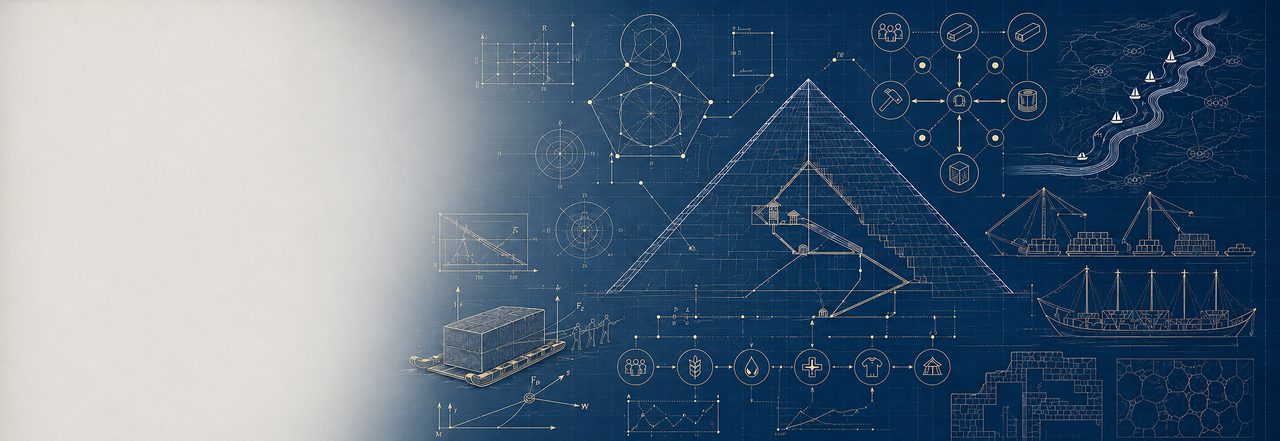
Engineering schematic linking Great Pyramid construction, block transport, labor, materials, and logistics.

The Engineering Required to Build Ancient Megaliths

What would it have taken to quarry, move, and place the stones, and keep the entire effort supplied?

Quantifying Antiquity examines the labor, materials, tools, transport, and planning ancient construction would have required. Published evidence becomes measurable requirements that anyone can examine and challenge.

Test the model

A forensic constructibility audit of the Great Pyramid of Giza

How the Great Pyramid Was Built Needs a New Explanation

The Pyramid would not have been built one isolated demonstration at a time. The entire system would have had to work at once and sustain itself over the build.

This audit holds a mathematical mirror to the explanation taught today. It takes that explanation’s own evidence and proposed methods, calculates what they would have required, and tests whether those requirements could have been met.

Labor, timber, rope, copper, and granite transport fail separate tests. Fixing one does not resolve the others. The complete construction plan fails too.

That shifts the burden of proof. Defending the explanation now requires showing how the work could have been completed, with the necessary people, materials, and methods carried through the entire build.

The result

Old Kingdom Egypt could not have built the Great Pyramid using the methods and resources attributed to it.

The labor, material supply, and granite transport requirements fail separate tests. Combining the work into one construction plan does not resolve those failures; it adds competing demands on the same people, supplies, and time.

Changing this conclusion requires evidence or calculations that resolve the failures and show how the complete build could have been carried out.

Findings

The failure appears across multiple fronts.

These findings do not depend on a single disputed assumption or one population total. They identify separate material, demographic, logistical, and physical limits. The complete construction program also fails when the same demands must operate together.

Finding 01

Timber

The complete timber system requires approximately 4,130.5 m³ of felled timber each year and 82,609.5 m³ over twenty years. That is approximately 60.19 Snefru-ship equivalents annually and 1,203.8 over the build. Ship equivalents describe the scale of the complete timber system; they do not mean that every cubic meter is imported cedar. Under the model’s 50% native-timber concession, the literal imported requirement is approximately 30.09 shiploads a year and 601.9 over the build. That is 15.05 times the forty-ship documented delivery.

Read the white paper Test the model

What was left out

Quarrying, transport, lifting, and placement would each have required more than the workers performing the immediate task. Tools would have worn out. Materials would have needed replacement. Workers would have needed food, water, rest, and support. The audit counts those requirements and carries them through the build. Multiple operations fail their own tests, and the complete construction plan fails too.

The systems question left unanswered

Can all the conventional claims coexist?

The Great Pyramid was a real construction project, not a series of isolated demonstrations. Its operations had to run together at the required rate while drawing on the same finite workers, materials, routes, food, water, and state capacity.

01
Test the published claim

Use the publications, open data, and attributed archaeological evidence, and the claimed construction schedule.

02
Follow every consequence

Count materials, wear, replacement, transport, workers, families, food, water, maintenance, and support.

03
Make the answers coexist

Run the narrative’s simultaneous demands against the same modeled kingdom and stop any resource from being used twice.

A working part is not a working project. Every required function must operate inside the same system.

The logic behind the connected system

Solving one task creates work somewhere else.

Every proposed solution has consequences. Leaving them out can make one operation look workable while the complete project still fails.

01

Ramp

Traffic Plank wear New timber Shape planks Transport Install

Published data on movement along the ramp determine the traffic used in this calculation. The audit separately specifies the wooden surface and how long the planks would have lasted. Under those assumptions, worn planks would have required replacement timber, cutting, transport, installation, and support throughout the build.

02

Worker

Household Settlement Food Water More carriers More demand

A worker roster is not the whole population attached to the project. Households need housing, food, and water, and delivering those supplies requires more people.

03

Copper tool

Mining Smelting Smelting fuel Casting Wear Replacement

Copper tools must be made and repeatedly replaced. That keeps the mines, smelters, fuel supply, foundries, and distribution system operating across the claimed build.

04

Barge

Hull timber Crew Harbor Shore lift Refloat Unload

Enough displacement can float a loaded beam. It cannot lift the beam from land, place a barge beneath it, pull the heavier barge into deep water, or unload it.

Test an alternative

You can change the method. You cannot delete the function.

Choose a common answer to the audit. The immediate advantage is credited, then the physical consequences are returned to the same connected system.

Proposed change

Reduce the force required from each puller

What it improves

Fewer pullers at the rope

What follows

  • Longer rope travel
  • Anchors and rigging
  • Setup and reset time
  • Rope wear and replacement
  • A larger operating footprint

The boxed-canyon principleThe model allows the pulling burden per person to fall. Mechanical advantage does not erase hauling; it exchanges force for distance, equipment, time, wear, and space.

The failures are simultaneous, not alternatives. A proposed correction must clear every failure it affects, not just one.

Granite transport · From quarry to placement

A barge solves only the water between the banks

The audit counts the heavy-beam expedition, an eight-barge fleet, and the river-and-harbor organization. River transport of the full 8,000-tonne granite mass requires 100 voyages across 3.79 transport seasons. The audit grants granite bedrock at Aswan and finds the river schedule feasible on paper, but the published account fails at getting the beams onto and off the vessels. Aswan extraction and dressing also remain required but contribute zero to the finding because published evidence provides no defensible basis for granite productivity or tool wear.

01 Aswan quarrying productivity unpriced · adds zero to the current finding
02 Overland haul approximately 1,067 haulers · rope train over 425 meters
03 Shore lift floating transfer fails · 4.10 times tolerance
04 Barge river schedule feasible · crews and support counted
05 Refloat 218-tonne laden vessel · no published refloat method
06 Unload fails below a 5.33 m² bearing footprint
07 Placement required work · no complete published method

Buoyancy solves the middle of the trip.
It does not solve the banks.

Read the granite explainer

Why the model has to be complex

The complexity is necessary because the project was connected.

The conventional account looks simple when quarrying, ramps, transport, tools, workers, food, and water are explained one at a time. In the claimed build, those demands have to run together against the same finite resources, for the same number of years.

How to check it

The homepage is the summary. The public research paper, technical white paper, and interactive model are the record.

Each row shows where a claim is controlled and what the model says about it.

Area Finding Status Public record
Whole modeled system The burdens already counted exceed the modeled limits Does not close White paper Model System closure
Sustained worker mobilization The program requires 47,342 men drawn from farming at one time, 61.6% of the modeled non-farm male labor pool, leaving 29,458 for every other non-farm function Does not close White paper Model System closure
Worker settlement The on-site workforce is 47,316, or 11.27 times the model’s 4,200-worker settlement benchmark. This produces an implied on-site population of 281,643 Does not close White paper Model Workers and settlement
Replacing the ramp’s wooden planks under the audit’s assumptions 26,743.5 m³ installed, 69,265.8 m³ felled once conversion loss is applied — 25.23× the 2,745 m³ comparator Exceeds historical record White paper Model Ramp and timber
Complete timber system 82,609.5 m³ felled over the build — 30.09× the comparator; 1,203.8 shipload equivalents against 601.9 literal imported shiploads Exceeds historical record White paper Model Ramp and timber
Rope and fiber 567.2 t of rope a year including production waste — 17.45 first-rate rigging equivalents, one every 2.98 weeks Exceeds historical record White paper Model Rope and fiber
Copper tools Quarry tools require 27.54 tonnes of new copper production each year and 550.7 tonnes over twenty years. That is 7.16 times Bir Nasib’s long-run annual average and 11.01% of its estimated total output across a 1,300-year operating span. The separate shaping and setting copper diagnostic remains outside this comparison Quantified burden White paper Model Copper and tools
Water delivery, including laborers 3.39 million liters must be delivered every day Counted through feedback White paper Model Water and support
Food production and delivery At minimum, feeding the project requires 45,282 grain farmers and 226,410 people including the farmers and their dependents. Once the food needed to support those additional farmers and families is also counted, the requirement rises to 1,603,797 people, or 100.2% of the 1.6-million population anchor Does not close White paper Model
Granite transport Expedition and river/harbor labor integrated. Shore footprint 5.33 m² against 1.5 m² available; deck-edge movement 0.410 m at 4.10× the 0.10 m tolerance; break-even waterplane 3,200 m², a 246 m hull at the modeled 13 m beam; the 1,323 m² comparator still moves 2.42× tolerance Capability gap White paper Model Granite from Aswan
What comes from sources, and what is assumed

The audit intentionally begins with the published evidence the conventional account itself relies on, open datasets, conventional attributions, and disclosed assumptions. Historical dates, reign assignments, builders, and construction schedules remain claims supplied by that narrative; the audit does not convert them into facts. Source badges distinguish external evidence from calculations and judgment calls.

What “open” means

Open does not mean unnecessary or physically free. It means a required function remains disclosed while its evidence, productivity, mechanism, feedback, or double-counting controls are not ready for defensible integration. It contributes zero to the headline result specifically so uncertainty cannot be used to inflate the audit’s finding.

How to challenge the audit

Identify the source, assumption, calculation, or method you believe is wrong. Show the correction and carry it through every result that depends on it. A corrected finding changes; unrelated failures do not disappear. Reversing the overall conclusion requires resolving the remaining failures and showing how the complete build could have been carried out.