Finding 06 Capability gap
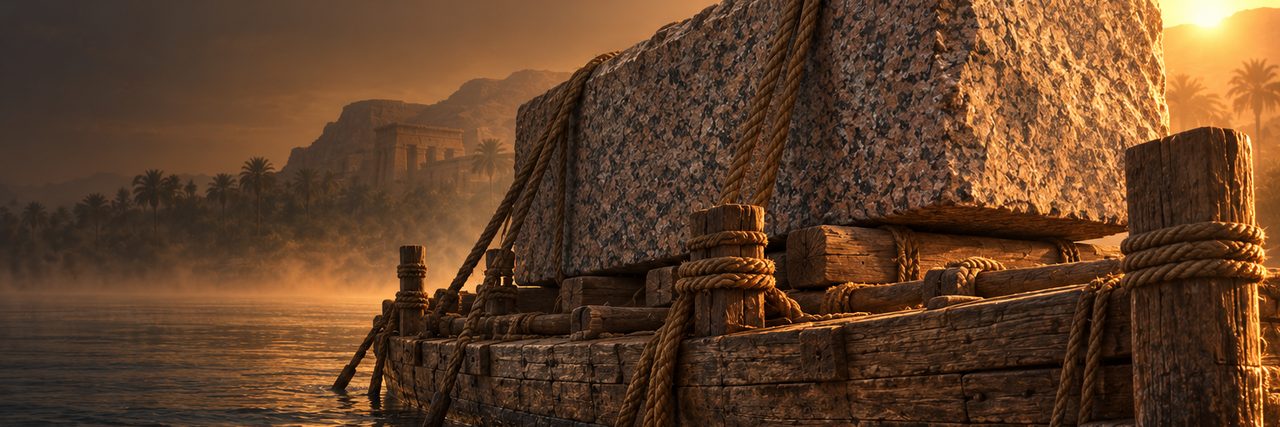
Loading 80-Tonne Granite Beams onto a Barge
4.1× the loading tolerance
The granite result changes the question from the scale of supply to whether the required operations can physically occur.
- deck-edge movement as the beam comes aboard
- 0.410 m
- the 0.10 m transfer tolerance
- 4.10×
- waterplane needed to stay within tolerance
- 3,200 m²
What the audit found
Loading an 80-metric-ton beam onto a floating vessel depresses the receiving edge before the full hull can settle evenly. On the modeled 60-by-13-meter box barge, the 80-metric-ton beam produces 0.410 meters of deck-edge movement against a 0.10-meter transfer tolerance, a factor of 4.10.
Break-even requires 3,200 square meters of waterplane, equivalent to a hull 246 meters long at the modeled 13-meter beam. The largest attested Egyptian vessel of any period provides approximately 1,323 square meters. Even that hull permits 0.242 meters of edge movement, 2.42 times the transfer tolerance. The box-barge approximation maximizes waterplane within the stated dimensions; a real hull with finer ends performs worse.
At Giza, a lifting system operating on soft harbor or floodplain ground must distribute the 80-metric-ton beam over at least 5.33 square meters to remain within the modeled bearing capacity. Grounding the vessel avoids the instability of a floating transfer, but it does not solve the operation. It moves the failure into ground bearing, restraint, and refloat.
How the loading figure is built
-
The load
An 80-tonne granite beam moves onto the modeled 60 × 13 m box barge, a waterplane of 780 m².
-
Edge movement
Sinkage plus trim or heel lowers the loaded edge by 4W ÷ A, where W is the load as displaced water and A the waterplane: 0.410 m.
-
Against the tolerance
The transfer tolerance is 0.10 m, so the edge moves 4.10 times too far, whether the beam comes over the end or the side.
-
Break-even
Staying within 0.10 m needs 3,200 m² of waterplane, a hull 246 m long. The largest attested vessel, 1,323 m², still moves 2.42 times too far.
Detailed results
| Measure | Value |
|---|---|
| Deck-edge movement, modeled barge | 0.410 m (4.10×) |
| Transfer tolerance | 0.10 m |
| Break-even waterplane | 3,200 m² (a 246 m hull) |
| Largest attested vessel | 1,323 m²; 0.242 m (2.42×) |
| Minimum lifting footprint at Giza | 5.33 m² (1.5 m² modeled) |
| Bearing pressure on the modeled footprint | 53,333 kg/m² against 15,000 |
| Horizontal restraint when sliding the beam | about 235 kN (24 tonnes-force) |
| Laden vessel displacement | about 218 t |
| Hull timber, eight-vessel fleet | 435.94 t worked; 1,129.08 t felled |
What would reverse it
Stability: a transfer method that avoids the moving edge or a hull above the waterplane threshold.
Bearing: a larger loaded footprint or demonstrated prepared bearing surface.
Restraint and refloat: defined, attested, and fully burdened restraint and recovery mechanisms.
Sources and Assumptions
Where each input behind the granite transport finding comes from, how much weight it carries, and where the full argument is published.
Inputs and how they are treated
| Input | Value | Treatment |
|---|---|---|
| Transfer tolerance | 0.10 m | Assumption. |
| Ground bearing capacity at Giza | 15,000 kg/m² | Assumption. A prepared high-capacity bearing surface would change the result and is an explicit reversal condition. |
| Modeled vessel | 60 × 13 m box barge | The box shape maximizes waterplane within those dimensions, which favors the conventional scenario. |
| Comparator vessel | 63 × 21 m; 1,323 m² | A reconstructed New Kingdom obelisk barge, long after the period in question and contested. Used only as a magnitude comparison. |
| River fleet and crews | eight barges; 743 people | Granted, and anchored to the Diary of Merer. The river corridor is feasible on the modeled schedule. |
Limits of the finding
The river result establishes only that the voyages fit the modeled navigation window and that the river workforce has been counted. It does not provide the vessels or solve loading, deck stability, restraint, unloading, grounding, refloat, or repair.
The analysis makes no equivalent soft-ground claim at Aswan, where the loading environment is granite bedrock.
No published conventional explanation supplies the 3,200-square-meter waterplane required to pass the loading test.
References
- Tallet, Pierre. 2017. Les papyrus de la mer Rouge I: Le Journal de Merer. MIFAO 136.
- Tallet, Pierre, and Mark Lehner. 2022. The Red Sea Scrolls: How Ancient Papyri Reveal the Secrets of the Pyramids.
- Lehner, Mark. 2020. “Lake Khufu: On the Waterfront at Giza.” In Profane Landscapes, Sacred Spaces, 191-292. Equinox.
- Younes, Gamal, et al. 2024. “The Pyramid Builders’ Waterways: Reconstructing the Ancient Topography of Khufu’s Pharaonic Harbour at Giza, Egypt.” Journal of Archaeological Science: Reports 53:104303. https://doi.org/10.1016/j.jasrep.2023.104303
- Hemeda, Sayed, and Alghreeb Sonbol. 2020. “Sustainability Problems of the Giza Pyramids.” Heritage Science 8:8. https://doi.org/10.1186/s40494-020-0356-9
Where this is documented
- Research paper, Section 6.8
- Research paper, Section 4.2: river transport
- White paper, Section 10.1 and Findings F28-F29
- Common objection: Couldn't ballast, quays, a bigger barge, or an overland route have moved the granite?
- Common objection: Couldn't they have used pulleys or levers?
- Granite from Aswan explainer
- The interactive model, where every input on this page can be changed and the whole program recalculates