
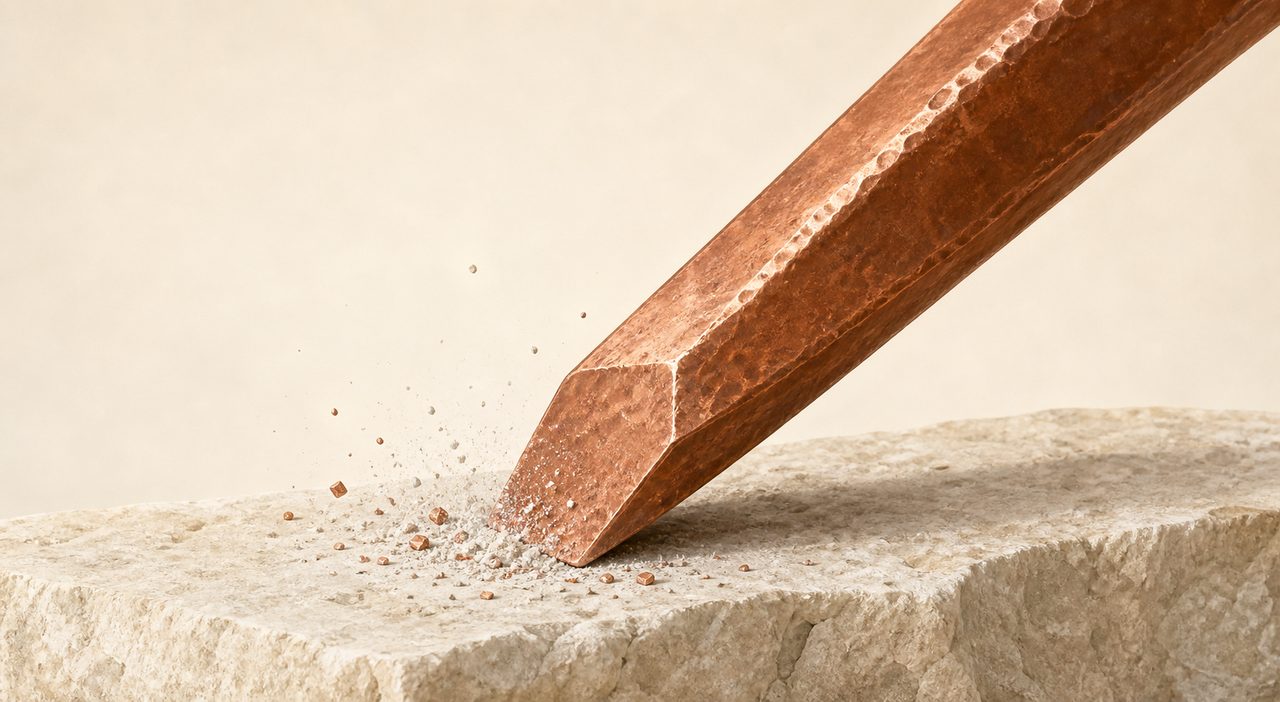
The basic fact
Every strike costs a little copper.
The conventional account says copper tools helped cut and shape the pyramid stones. If that story is true, the tools had to wear down, and the copper had to keep coming.
How the model handles copper
The model does not simulate every single chisel stroke. It stays inside the conventional claim, then estimates the copper that claim would consume.
Use the claimed 20-year build period and the usual block count.
This calculation uses about 206 blocks per day to work out how much copper the tools used for quarrying would have needed. That is one block every seven minutes across twenty-four hours. It is the model’s setting for this calculation, not the result of dividing 2.3 million blocks by twenty years.
The quarry and rough-shaping work implies a large group using copper tools daily.
The default uses 50 g of copper lost per tool user per day after recycling. ?
Failed casts, slag, transport, and other losses mean more copper has to be produced than reaches a tool edge.
Try the copper-loss setting
This is not one chisel, one saw, or one hammer. It is copper lost per claimed copper-tool user for one day.
The displayed 27.54-tonne annual quarry-tool requirement excludes a separate 1.3797-tonne-per-year shaping and setting copper diagnostic. Including that diagnostic raises the annual Bir Nasib production multiple from 7.16 to approximately 7.52. The quarry-tool figure is reported on its own because it is the governed one; the supply problem appears without the diagnostic.
Where was all that copper supposed to come from?
Bir Nasib is the major Sinai copper source used for comparison. Its generous all-time estimate is about 5,000 tonnes spread across roughly 1,300 years, and much of that copper comes from periods later than Khufu.
The tool claim needs almost eight years of average Bir Nasib copper every single year.
The tested claim uses about 11% of all copper estimated from Bir Nasib across its whole known history.
It takes about 143 normal Bir Nasib years and squeezes them into the claimed build period.
This is not one year of copper. It is Bir Nasib’s estimated total across roughly 1,300 years.
Copper is never just copper.
Once a claim requires large amounts of copper tools, other burdens appear automatically.
People have to mine ore and turn it into usable metal.
Smelting needs charcoal or other fuel, and that fuel has its own supply chain.
The metal has to move from the mining region to the tool users.
Tools have to be cast, repaired, sharpened, and replaced continuously.
The extra people in that chain also have to be supported.
What this test is saying
The tools used for quarrying would have required 27.54 tonnes of new copper each year in the published model. That is more than seven times Bir Nasib’s average annual production. Over twenty years, the requirement reaches 550.7 tonnes: about 143 years of that average production, needed within a twenty-year build.
That copper would have needed mines, furnaces, fuel, transport, and people to make and repair the tools. Those workers would have needed supplies of their own. The construction explanation must account for all of that work throughout the build.
Reversing this finding requires evidence for a supply system capable of delivering copper at the required scale and duration.
Direct shaping, fitting, setting, casing, and rework labor is integrated into M3 as Wave 1. What remains outside the displayed quarry-tool material total is the separate shaping and setting copper diagnostic and its supporting material chain — not the people doing the work.